
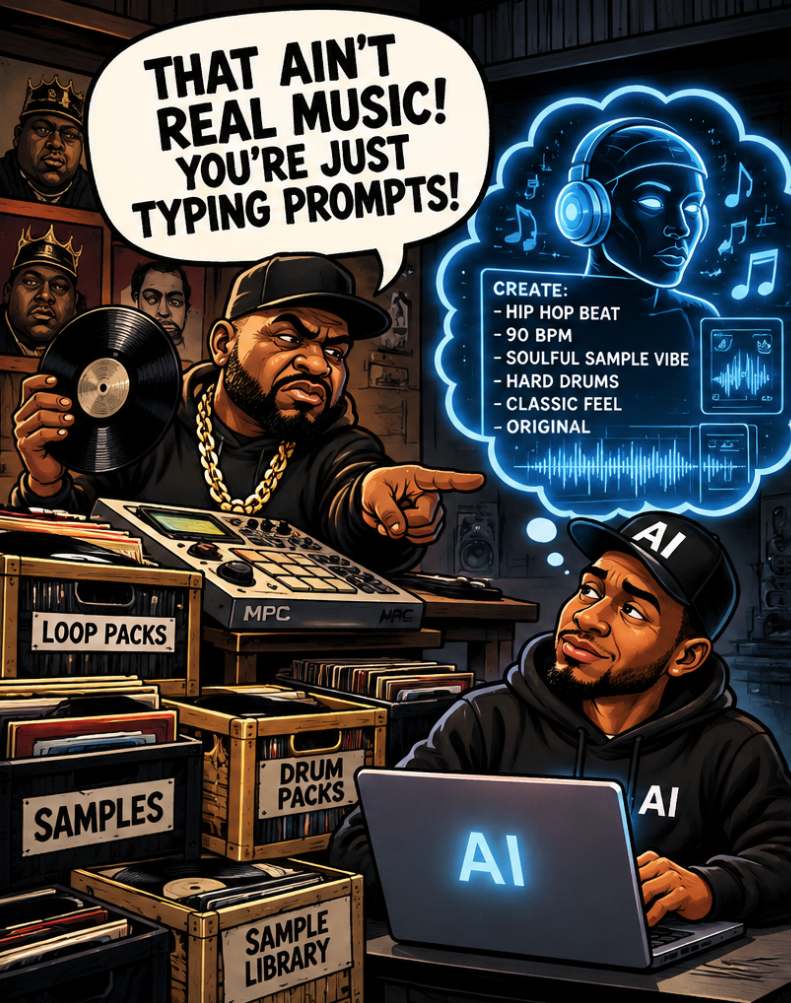
Apparently, taking somebody else's drum break, looping somebody else's melody, and rearranging somebody else's musical ideas is an art form. But typing a description into an AI generator? Well, now you've gone and destroyed the integrity of music.
Welcome to the Church of the Sacred Drum Pad
Somewhere in America, a producer is sitting in front of a $3,000 computer, running a $500 digital audio workstation, browsing through 10,000 royalty-free samples, searching for a drum loop that sounds like something from 1994.
He finds one.
He downloads it.
He drags it into his session, lowers the pitch two semitones, adds a kick drum, and presses play.
Then he leans back in his chair, folds his arms, and announces that artificial intelligence is destroying creativity.
Ladies and gentlemen, we have found the last guardian of authentic musicianship.
Apparently, the difference between artistic genius and technological laziness is whether you clicked a mouse or tapped a rubber drum pad before letting the computer do the rest.
Welcome to modern music production, where borrowing is an art form, automation is a convenience, and artificial intelligence is somehow cheating.
Unless, of course, you're using it yourself.
Sampling: The Original Copy-and-Paste Culture
Let's establish something immediately: sampling is fundamental to hip-hop.
Without it, the genre might never have developed into the cultural and commercial force it became.
Hip-hop pioneers transformed existing recordings into entirely new musical experiences. Breakbeats were extended, rhythms were rearranged, obscure records were rediscovered, and familiar sounds were given new identities.
That was innovation.
The creativity involved in discovering, manipulating and recontextualizing recorded music deserves recognition.
But somewhere along the way, an interesting contradiction developed.
A producer can take a four-bar section of somebody else's recording, chop it into pieces, rearrange those pieces and proudly declare the result an original production.
Another creator can instruct an artificial intelligence system to generate a composition with specific instrumentation, tempo, structure, mood and arrangement, then be accused of having absolutely no creative ability.
Why?
Because one person pushed buttons on a drum machine while the other typed instructions into a keyboard?
Apparently, the keyboard becomes morally unacceptable when the instructions are written in English instead of MIDI notes.
Congratulations, You Moved the Snare
Let's talk about sample packs.
Modern music production software provides enormous libraries of professionally recorded sounds.
There are drum loops, bass lines, keyboard progressions, guitar riffs, vocal phrases, orchestral arrangements and complete musical construction kits.
Some producers build remarkable compositions from these materials.
Others make remarkably little effort to disguise where their music came from.
Download a loop.
Change the tempo.
Add a hi-hat.
Move the snare slightly to the left.
Congratulations. You're a visionary.
But let somebody type, "Create a laid-back neo-soul instrumental with warm electric piano chords, a syncopated bass line and a relaxed 92 BPM groove," and suddenly the entire music industry needs an emergency meeting about artistic integrity.
The producer who spent fifteen minutes rearranging a premade loop now wants to lecture the person who spent fifteen minutes refining an AI prompt about the importance of hard work.
We should probably give him a standing ovation.
Just make sure the applause is royalty-free.
The Great Hands-On Illusion
One of the most entertaining arguments against AI music is that traditional producers are more involved in the creative process because they physically interact with their equipment.
They turn knobs.
They press pads.
They slide faders.
They click little boxes on computer screens.
Apparently, touching something is what makes it art.
By that standard, a person who spends an afternoon operating a microwave should qualify as a professional chef.
Modern digital audio workstations have been automating musical tasks for decades.
Quantization corrects timing.
Pitch correction adjusts vocals.
Arpeggiators generate note sequences.
Drum sequencers repeat patterns.
Virtual instruments reproduce sounds that once required actual musicians.
Chord tools help construct progressions.
Preset libraries provide sounds designed by somebody else.
And nobody seems particularly interested in confiscating a producer's credentials because he used a software compressor instead of building one himself.
Technology has always reduced the amount of manual labor required to produce music.
The argument that creative legitimacy depends on physical interaction with equipment becomes increasingly difficult to defend when so much contemporary production already relies on automation.
A mouse click is not inherently more artistic than a written instruction.
A drum pad is not a certificate of originality.
And owning expensive equipment does not automatically make somebody creative.
But AI Didn't Create Anything. You Just Told It What to Do!
This may be the most frequently repeated criticism of prompt-based music creation.
"You didn't make that music. You just told the computer what you wanted."
Interesting.
Because when a record producer tells a keyboard player to try a different chord progression, asks a drummer to change the groove or instructs an engineer to adjust the mix, we generally recognize those decisions as part of the production process.
The producer may not physically play every instrument.
The producer may not write every note.
The producer may not personally operate every piece of equipment.
Yet creative direction remains a recognized part of music production.
Of course, directing human musicians and prompting a generative model are not identical activities. Human collaboration involves musicianship, interpretation, relationships and creative contributions that software does not reproduce in the same way.
But the underlying question is worth examining.
If someone develops a musical concept, specifies its characteristics, evaluates the results, rejects unsuccessful versions, revises the instructions and ultimately selects the arrangement that best communicates the intended idea, has that person exercised creative judgment?
Certainly.
Does that mean the person possesses the same skills as a trained instrumentalist, composer or recording engineer?
Not necessarily.
Those are two different questions.
The mistake is assuming that a different creative process automatically means no creativity exists.
The Difference Between Using a Tool and Being Used by One
Now, before every AI enthusiast starts polishing a Grammy acceptance speech, there is another side to this discussion.
Typing "make me a hit song" and accepting the first result does not demonstrate the same degree of musical craftsmanship as composing, arranging, recording and mixing an original production.
Neither does downloading an entire instrumental, changing its title and claiming to have produced a masterpiece.
Minimal effort is minimal effort, regardless of the technology involved.
A lazy producer with a drum machine is still a lazy producer.
A lazy producer with artificial intelligence is still a lazy producer.
The technology does not determine the level of creativity.
The person using it does.
Some producers spend hours manipulating samples until the finished recording bears little resemblance to the source material.
Others drag an eight-bar loop into a session and call it a day.
Likewise, some AI music creators accept whatever a generator produces, while others experiment extensively with arrangements, lyrics, instrumentation, structure and post-production.
Those differences matter.
The meaningful comparison is not between sampling and artificial intelligence as abstract technologies.
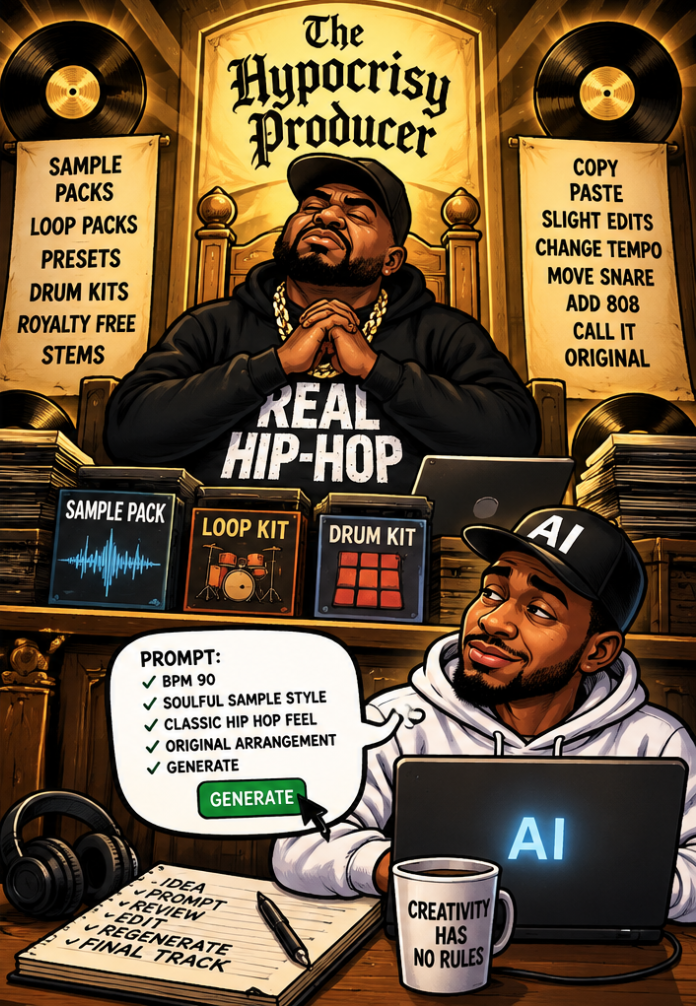
It is between the actual creative decisions made by the people using them.
The Copyright Argument Is Real. The Hypocrisy Can Be Real, Too.
There are legitimate reasons for musicians to question the growth of generative AI.
Copyright infringement, unauthorized training data, voice imitation, compensation and the displacement of working musicians are serious concerns.
Artists have every right to question whether their recordings should be used to train commercial systems without permission or payment.
A sample taken from a copyrighted recording can also require permission, and the legal issues surrounding sampling and AI-generated material are not identical.
Licensed sample packs, for example, generally provide specified usage rights. The legal status of material used to train an AI model may be more complicated and subject to ongoing disputes.
Those distinctions should not be ignored.
But the existence of legitimate concerns does not excuse inconsistent arguments.
If a producer's objection is that AI systems may exploit copyrighted music without authorization, that is a substantive position.
If the objection is simply that AI users rely on computers to generate musical material, while the same producer relies on computer-generated patterns, prerecorded loops and automated production tools, the argument becomes considerably less convincing.
Criticize unauthorized exploitation.
Defend artists' rights.
Demand transparency.
But don't pretend the artistic value of a recording can be measured by how many times somebody touched an MPC.
Every Generation Thinks the Next Generation Is Cheating
The resistance to AI follows a familiar pattern in music history.
Electronic instruments once faced skepticism from musicians who preferred acoustic performances.
Drum machines challenged the traditional role of live percussionists.
Sampling created disputes over originality and ownership.
Digital recording disrupted established studio practices.
Pitch correction became both a production tool and a cultural punchline.
Bedroom studios challenged the idea that professional recordings required expensive commercial facilities.
And now generative artificial intelligence has arrived to threaten another collection of established assumptions.
Each technological shift has changed the skills required to participate in music creation.
Some traditional skills have become less commercially necessary.
Others have become more valuable.
New creative practices have emerged.
None of this guarantees that every technological development improves music.
It does, however, suggest that declaring a new tool illegitimate simply because it makes production more accessible is a poor substitute for evaluating the work itself.
After all, hip-hop became revolutionary partly because its pioneers refused to accept traditional definitions of what qualified as a musical instrument.
A turntable became an instrument.
A sampler became an instrument.
A drum machine became an instrument.
Now, suddenly, a computer receiving detailed creative instructions is where we must draw the line?
How convenient.
The Real Fear Might Be Competition
There is another possibility that deserves consideration.
Perhaps some resistance to AI is not exclusively about artistic integrity.
Perhaps it is also about competition.
For decades, access to professional music production depended on equipment, training, studio time and industry relationships.
Technology gradually reduced those barriers.
Today, a person with limited musical training can experiment with arrangements and recordings that would once have required significant resources.
That does not make the resulting work equal to the output of an accomplished producer.
But it does allow more people to participate.
And increased participation can be uncomfortable for people whose professional identity is partly connected to possessing specialized tools or knowledge.
The answer is not to dismiss every newcomer as an impostor.
It is to demonstrate why experience, musicianship and creative judgment still matter.
A genuinely accomplished producer should have advantages that extend far beyond operating software.
The ability to recognize an extraordinary melody, construct an emotionally effective arrangement, direct a vocalist or develop a distinctive sound remains valuable regardless of how accessible technology becomes.
If the only thing separating a veteran producer from a beginner is the ability to press a particular sequence of buttons, perhaps the problem is not artificial intelligence.
The Audience Has the Final Vote
Here's the uncomfortable reality.
Most listeners do not know how their favorite recordings were produced.
They do not know which drum machine generated the beat.
They do not know whether the bass line was performed live, programmed through MIDI, sampled from an older recording or generated with software.
They generally do not know how many presets were used or how many hours were spent editing the arrangement.
And unless those details become part of the song's public story, many listeners never ask.
They respond to the music.
Does it move them?
Does it make them dance?
Does it communicate something meaningful?
Do they want to hear it again?
Production methods can matter ethically, legally and artistically. Audiences may reasonably care about authenticity, credit and the treatment of working musicians.
But a recording does not automatically become enjoyable because its creator used traditional equipment.
Nor does it automatically become terrible because artificial intelligence played a role in its development.
The finished work still has to connect with people.
Amplifier's Final Word: Put Down the Pitchfork and Pick Up Your Sampler
Let's be clear.
Traditional hip-hop producers deserve respect for developing a musical culture that transformed existing technology into a new artistic language.
Sampling is not inherently lazy.
Using loops is not inherently lazy.
Using virtual instruments is not inherently lazy.
And using artificial intelligence is not inherently lazy.
What deserves criticism is the belief that one method of computer-assisted creativity is automatically superior to another simply because it has been around longer.
If you spend three hours transforming a sample into something extraordinary, congratulations. You've demonstrated creativity.
If you spend three hours directing, revising, arranging and refining AI-generated musical material into something compelling, you've also made creative decisions.
If you download somebody else's loop, add a kick drum and spend the rest of the afternoon complaining that AI producers have no talent, perhaps your time could be better spent.
Maybe try writing a melody.
Or learning an instrument.
Or, here's a revolutionary idea, making a record so good that nobody cares how it was produced.
Because the future of music will not be decided by which producer has the most expensive drum machine, the largest sample library or the most sophisticated AI subscription.
It will be shaped by people who have something worth expressing and the imagination to express it.
And to the producer who insists that typing prompts isn't making music while proudly assembling beats from prerecorded loops:
Congratulations. You've successfully defended the sacred tradition of letting a computer do the work—as long as you get to press the buttons.
Now excuse us while we sample that argument, pitch it down three semitones and add a little reverb.
We think it might make a hit.
Amplifier Music Magazine — Editorial Opinion
This commentary critiques production practices and industry attitudes rather than any particular artist. Sampling, licensed sound libraries, AI-assisted production and fully generative music involve different creative and legal considerations. The purpose is to examine inconsistent standards for evaluating musical creativity.